EBC Webstore
Eastern Book Company

|
|||
|
|||
 Home > GLOBAL > Politics & Government > Political structure & processes > Elections & referenda > 2025 Home > GLOBAL > Politics & Government > Political structure & processes > Elections & referenda > 2025 |


.jpg)


 5
5
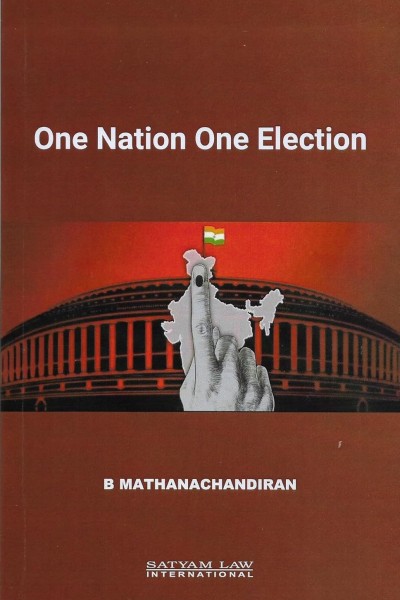
One Nation, One Election refers to a proposal for conducting simultaneous elections for all the major legislative bodies in India- specifically, the Lok Sabha (the lower house of Parliament) and all State Legislative Assemblies. This means holding elections for the central government and state governments at the same time across the country.
The concept of One Nation, One Election has been debated for several years in India. The idea is rooted in the concern that frequent elections disrupt governance, lead to a lack of focus on development work, and drain public resources. It aims to bring about efficiency in the electoral process and ensure better governance by reducing the frequency of elections.
CHAPTER 1 — Introduction
Page 1
1.1 Background of One Nation, One Election – 1
1.2 Historical Context – 2
1.3 Importance of Simultaneous Elections – 6
1.4 Conceptualizing the Need for One Nation, One Election – 10
CHAPTER 2 — Parliamentary Democratic Process and Elections
Page 15
2.1 Role of Elections in Democracy – 15
2.2 Types of Elections in India – 19
2.3 Election Cycle and Its Implications – 23
CHAPTER 3 — Evolution of Parliamentary Democratic Process in India
Page 29
3.1 Post-Independence Electoral Developments – 29
3.2 Shift from Simultaneous to Staggered Elections – 32
3.3 Impact on Governance and Development – 37
CHAPTER 4 — Constitutional Provisions to Elections
Page 42
4.1 Provisions Relating to the Election of President – 42
4.2 Election of Vice-President – 46
4.3 System of Election to Lok Sabha – 49
4.4 Elections to Rajya Sabha – 54
4.5 Elections to State Legislatures – 58
4.6 Composition of the Legislative Councils – 62
4.7 Adult Suffrage – 65
CHAPTER 5 — Election Commission: Role and Functions
Page 69
5.1 Structure and Powers of the Election Commission – 69
5.2 State Election Commissions – 73
5.3 Functions and Responsibilities – 76
CHAPTER 6 — Reservation of Seats
Page 82
6.1 Reservation of Seats in Lok Sabha – 82
6.2 Reservation of Seats in Vidhan Sabha – 86
CHAPTER 7 — Elections for Local Self-Government Institutions
Page 89
7.1 Elections to Panchayati Raj Institutions – 89
7.2 Elections for Municipalities – 93
CHAPTER 8 — Laws Dealing with Elections
Page 98
8.1 Representation of the People Act, 1951 – 98
8.2 Electoral Laws and Reforms – 102
8.3 Challenges in Electoral Laws Implementation – 106
CHAPTER 9 — One Nation, One Election
Page 112
9.1 Simultaneous Elections – Meaning and Scope – 112
9.2 Models of Simultaneous General Elections – 115
9.3 Concurrent Elections — Country-Specific Experience – 120
9.4 Simultaneous Elections — Indian Scenario – 126
9.5 The First Four General Elections after Independence — Brief Overview – 129
9.6 Recommendations of Various Committees on Simultaneous Elections – 133
9.7 Views Expressed on Simultaneous Elections – 138
9.8 Need for Simultaneous Elections – 142
9.9 Challenges for ‘One Nation, One Election’ – 146
References
Page 151



|

Click on TITLE to choose available options.
|
|
Click on TITLE to choose available options.
|

|
Click on TITLE to choose available options.
|

|
Click on TITLE to choose available options.
|

|
Click on TITLE to choose available options.
|
|
Click on TITLE to choose available options.
|

|
|

|
Click on TITLE to choose available options.
|
|
Click on TITLE to choose available options.
|
|
||
|
||
|