


EBC Webstore
Eastern Book Company

|
|||
|
|||
 Home > TEXTBOOKS > Entrance Examination Books > Pre-Law & Non Law Subjects > Legal Studies > 2025 Home > TEXTBOOKS > Entrance Examination Books > Pre-Law & Non Law Subjects > Legal Studies > 2025 |

.jpg)


 5
5
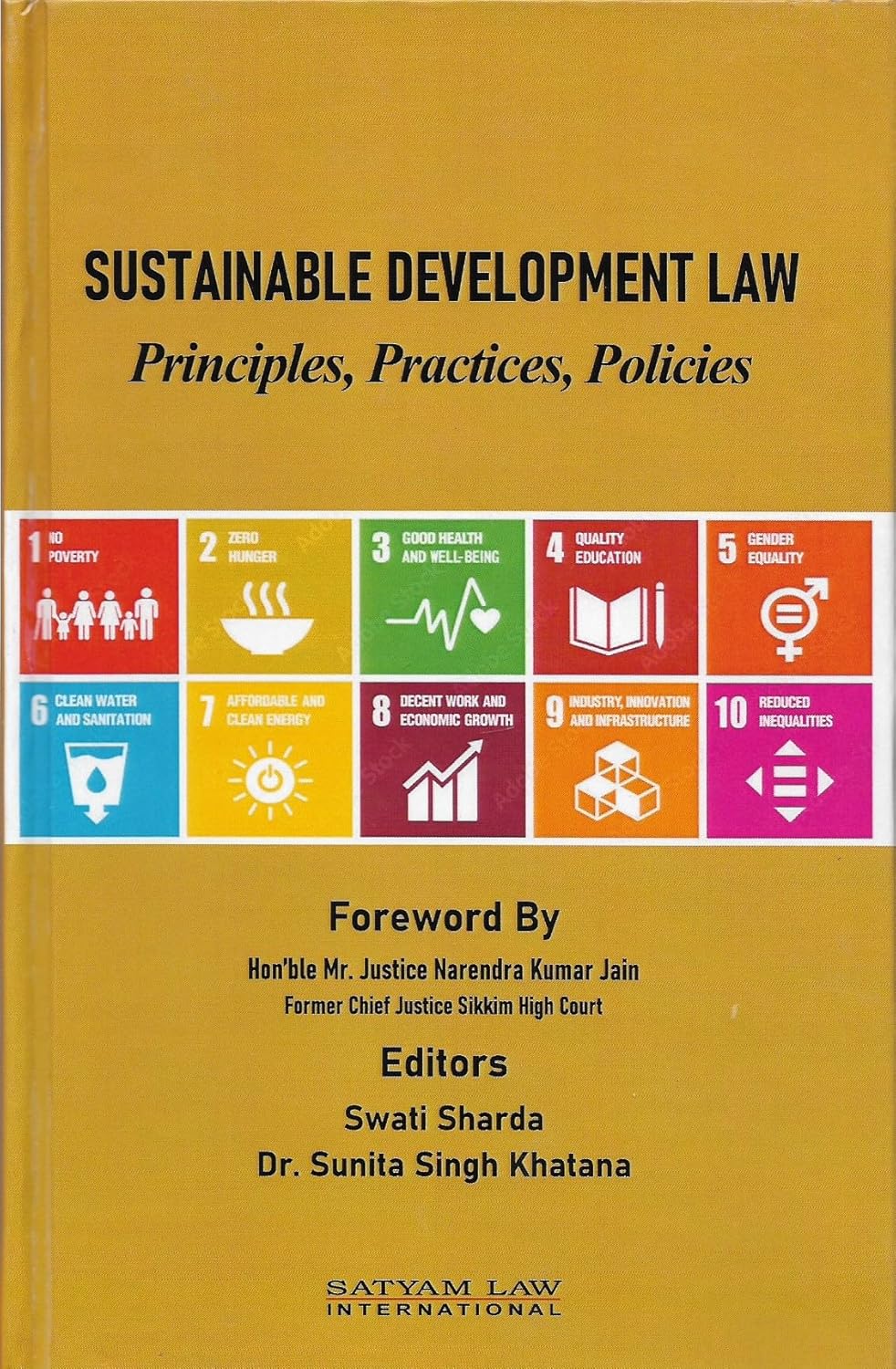
Nations worldwide have made sustainable development a crucial objective, seeking to achieve a harmonious balance between economic growth, environmental preservation, and social justice. This book aims to examine the complex and dynamic domain of sustainable development law, offering a thorough examination of its concepts, policies, and implementation.
This resource will be invaluable for legal scholars, policymakers, practitioners, and students who wish to comprehend how legal frameworks can effectively promote sustainable development goals (SDGs). The notion gained momentum following the publication of the 1987 Brundtland Report, titled "Our Common Future," which defined sustainable development as the practice of satisfying the current needs while safeguarding the capacity of future generations to fulfill their own needs. The original concept has transformed into a comprehensive framework consisting of 17 Sustainable Development Goals (SDGs) that were officially accepted by the United Nations in 2015.
These goals are designed to tackle worldwide issues such as poverty, inequality, climate change, and environmental degradation. Given the growing evidence of climate change and environmental deterioration, the importance of law in promoting sustainable development is more crucial than ever. Legal frameworks are crucial for the implementation of programs that effectively reconcile conflicting interests, enforce stringent environmental standards, and advance principles of social justice. Sustainable development law involves various legal disciplines, such as environmental law, international trade law, human rights law, and economic law. This book seeks to offer a thorough analysis of sustainable development legislation by delving into its fundamental concepts, global and regional frameworks, domestic applications, and rising obstacles. The book will provide readers with a comprehensive understanding of how legal instruments can effectively support and promote sustainable development goals by connecting theoretical concepts with actual implementations.
Chapter 1 India’s Leadership in Coastal Security, Climate Change, and Sustainable Development – Manish Kumar Singh – 1
Chapter 2 Protected Areas in IBL: Measuring the Current Level of Conservation and Sustainable Use of the World’s Biotic and Abiotic Resources by Legally Protected Areas – Rishabh Tomar – 13
Chapter 3 The Role of Intellectual Property in Advancing Green Trade Policies – Swati R. Jain – 29
Chapter 4 Access to Justice and the Role of Law in Achieving Social Equity – Dr. Rajiv Kumar Bhartiya – 47
Chapter 5 Atrocities on Men by Women in the Contemporary World – Anjali Chaudhary, Uttam Solanki – 57
Chapter 6 Unification of Indigenous Knowledge with Artificial Intelligence: Way Forward for SDG on Climate Action – Dr. Kanika Gaur – 67
Chapter 7 From Policy to Practice: Evaluating the Legal Framework for Achieving Sustainable Development in India – Eisha Surana – 79
Chapter 8 Environmental Governance in the Light of Sustainability – Karan Solanki – 93
Chapter 9 Climate Migrant’s Life Under Threat: Analyzing Global Efforts Dealing with Climate Change and Climate Migration (SDG 13) – Dr. Sincy Wilson – 105
Chapter 10 An Analysis of India’s Legal Framework for Sustainable Development – Mrs. R. Vimala – 121
Chapter 11 Legal Frameworks for Sustainable Water Resource Management: Integrating Land, Mineral, and Biodiversity Conservation – Siddharth P. Tyagi, Dr. Mayuri H. Pandya – 133
Chapter 12 Navigating the Green Wave: Exploring ESG Regulations in India and SEBI’s Initiatives – Sakshi Ranjan – 157
Chapter 13 Critical Analysis on Corporate Social Responsibility – Dr. Sunita Singh Khatana, Krupa Savajiyani – 169
Chapter 14 The Challenges Pertaining to Climate Change, Environmental Conservation, and Sustainable Development from Bioenergy via Bio-Forestry – Dr. J.K. Mony Angelus, Ms. Syed Ali Fathima Nisha – 175
Chapter 15 Legal Aspects of Sustainable Trade and Investment Policies in India: Navigating the Path to Sustainable Development – Dr. Deeksha Tewari – 189
Chapter 16 Energy Policy and the North East: A Case Study of Sikkim – Vaidyanath Nishant, Dr. E.K. Santha – 211
Chapter 17 Role of Corporate Governance and Environmental, Social and Governance (ESG) Disclosures in Achieving Sustainable Development Goals – Ashima Bhattacharjee – 229
Chapter 18 Human Rights Law and Sustainable Development: Bridging Justice and Environmental Stewardship – Nandana Rajesh – 241
Chapter 19 Women Empowerment, Sustainability and Inclusivity Through Local Self Government: The Kerala Model – Ms. Shyni KP – 255
Chapter 20 The Role of Corporate Governance in Achieving Sustainable Development Goals (SDGs) – Anmol Sharma, Kasak Saini – 267
Chapter 21 Sustainable Development for Climate Action – Parth Jakar, Shambhavi Singh – 281
Chapter 22 Access to Justice as a Pillar of Social Equity: Challenges and Opportunities – Ms. Shriya Badgaiyan, Ms. Manali Shrivastava – 291
Chapter 23 Behind Locked Doors: The Fight Towards Ending Marital Rape in India – Sangeeth Mathew Philip, Pragati Jain – 303
Chapter 24 Future Directions in Law and Sustainable Development – Ajay Sharma, Bibha Pothal – 309
Chapter 25 Advancing Decent Work and Labor Rights for Sustainable Development – Swati Sharda, Purnima Buragohain – 315



|

Click on TITLE to choose available options.
|
|
Click on TITLE to choose available options.
|

|
Click on TITLE to choose available options.
|

|
Click on TITLE to choose available options.
|

|
Click on TITLE to choose available options.
|
|
Click on TITLE to choose available options.
|

|
|

|
Click on TITLE to choose available options.
|
|
Click on TITLE to choose available options.
|
|
|
|
||
|
||
|


